







In the summer of 2017, I chaperoned a student trip to southern France. The trip was simply amazing from start to finish, with highlights for me being visits to several important Catholic Churches. One of those churches was the Cathedral of Saint Cecilia in Albi, the largest brick building in the world. The Cathedral, which took over 200 years to erect and was completed in 1493, resembled more of a medieval castle perched high on a hill overlooking the River Tarn than a church. Adorned in magnificent paintings and statuaries, housing a glorious pipe organ, and containing first class relics of Saint Cecilia herself, the church was one of the most beautiful and awe-inspiring holy sites I have ever visited. When leaving the Cathedral, we exited through the south baldachin (stone canopy), which was finished in the decades that followed the completion of the church itself. Two grotesque gargoyle-like relief sculptures embedded on either side of the exit and standing guard caught my eye. Amid the splendid glory of the building, one is left walking out and staring directly at these undesirable and seemingly out of place works of art on either side of the exit. Completely taken aback, I asked the tour guide what the meaning of these sculptures was and why they were there. He said it was all intentional. With the Cathedral’s completion just a year following Columbus’ first exploration, word traveled throughout Europe about the New World, and stories grew and became more embellished the further they went. Europeans were afraid of what could be found in these savage lands. The sculptures themselves, depicting horrendous human-like creatures with intimidating features, were placed at that very opening to describe not only the experiences of life, but spiritual experiences. The symbolism is that after being inside the splendor of the Cathedral, we leave and enter the uncivilized world.

Nearly a decade later, those words and that experience still resonate in my mind and the symbolism has taken on new and important meaning. It stands as a reminder that we could be enveloped in the beauty of God and yet still have to face and fight the evils of the world. But how do we do that? The simple answer is by remembering who is behind us also facing the evils – namely of the almighty power of God. Just as the Cathedral of Saint Cecilia sits like a fortress over the city of Albi, the Church is our fortress and stronghold to which we always find our shield. As Jesus told Saint Peter in Matthew 16:18, “You are Peter, and upon this rock, I will build my church, and the gates of hell shall not prevail against it.” The one, holy, Catholic, and apostolic Church always has our back in the face of difficulty, uncertainty, and danger, for in Jesus Christ we anchor our souls for all of eternity.
Father Demetrius Gallitzin took up this case as well in his letter, A Defense of Catholic Principles. In this letter, while describing and explaining Catholic doctrine, Father Gallitzin wrote, “Mankind having fallen by original sin into a wonderful state of depravity, the light of their reason being almost extinguished, their understanding perverted (witness the many ridiculous and abominable systems taught by their wise men and philosophers), their hearts corrupted and given up a prey to all the passions, Jesus Christ came not only to satisfy for our sins, and by that means to open for us the gates of heaven, but he also came to show both by word and example, what means we must take in order to obtain heaven.”
Father Gallitzin is absolutely correct. Man is corrupted again and again by sin, but Jesus Christ continues to show us how we overcome those sins, and the continuous work of the evil one, to obtain heaven. The world has always been a dangerous place. It is now, and it was during the time of Father Gallitzin and especially during the time Jesus walked the earth. He knew that His disciples were fearful of the mission that He was leaving them to complete. Jesus encouraged them and at the same time, continues to encourage us to follow Him back to God. In John 14:1-6, Jesus said to the disciples, “Let not your hearts be troubled. Believe in God; believe also in me. In my Father’s house are many rooms. If it were not so, would I have told you that I go to prepare a place for you? And if I go and prepare a place for you, I will come again and will take you to myself, that where I am you may be also. And you know the way to where I am going.” Thomas said to him, “Lord, we do not know where you are going. How can we know the way?” Jesus said to him, “I am the way, and the truth, and the life. No one comes to the Father except through me.”
There it is. Jesus created the roadmap through the pitfalls of our earthly life to the ultimate destination of Heaven and to be one with Him and the Father, and the Holy Spirit. The map is seemingly simple in design but yet so difficult for us to follow without stumbling blocks or detours. Our waywardness through daily life often lead us astray, and we find trouble when our hearts and minds are not fixed on the ultimate goal.
We must keep in mind that when God created the world, He created everyone and everything good. No one that God created is evil by His Hand, but by their own free will and weakness in succumbing to the temptations of the devil and of earthly pleasures. By following the road map that Jesus has created, we can use the good of the world for positive reasons and not for nefarious purposes.
In revisiting the New World sculptures at the Cathedral of Saint Cecilia, it is difficult in our world today to imagine the discovery of new lands and people, as we have spread throughout the globe. The near-instant communications, pictures, videos, and first-hand testimonials present almost everything in a way that leaves us no doubt as to what we are visualizing. In the late 1490s, this was not the case. The information that the people in southern France were circulating regarding the travels of a man and his crew, that, let’s face it, were terribly lost, was sketchy at best. Columbus returned to Spain in March of 1493. The news of his voyage took the better part of a year to overspread Europe, and by the time it reached Albi, France, I am sure it went through various iterations, as our stories today do when told second, third, or fourth hand. Imaginations run wild. People add their own embellishments. In the end, the story that remains is but a shred of the truth, which led the sculptor to create this image. The new world felt barbarous and godless to European society. They allowed their fears to run rampant. Fear of the unknown is one of the most common fears that we possess today, and I suspect that was also the case in the 15th century. We fear because we do not understand. Statistics have shown that around 92% of the things that cause us worry and fear never actually happen. We put our time and energy into worrying about what could be, instead of focusing on what is. Renaissance Europe was no different.
Here is what we need to remember: Just like me and millions of others over the last 500 years walking out of the Cathedral and seeing those sculptures, we need to remember that in the face of fear, evil, and danger, standing right behind us is Jesus Christ and the Church. The third verse of the hymn The Church’s One Foundation explains this very plainly:
‘Mid toil and tribulation
And tumult of her war,
She waits the consummation
Of Peace forever more;
Till with the vision glorious
Her longing eyes are blest,
And the great Church victorious
Shall be the Church at rest.
Until we can reach the ultimate goal of heaven, we must put on the armor of God, be a soldier of Christ. We must march out proudly with the Lord as our foundation and fight evil with the goodness and strength that He has provided us. Do not fear what is in front of you, for God is always with you and has your back!
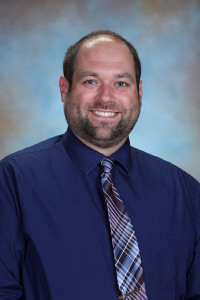
Jonathan Nagy, M.Ed., is the Principal of Bishop Carroll Catholic High School in Ebensburg and the Music Director at the Basilica of Saint Michael the Archangel in Loretto.