




Column by Jonathan Nagy
On October 28, in a letter entitled Disegnare Nuove Mappe Di Speranza (Drawing New Maps of Hope), Pope Leo XIV declared St. John Henry Newman to be a Doctor of the Church and a co-patron of Catholic education alongside the great Saint Thomas Aquinas. Additionally in this letter, Pope Leo called upon Catholic schools and educators to double down on who they are. He wrote, “When they are guided by the word of Christ, they do not retreat but press forward; they do not raise walls but build bridges. They respond creatively, opening new possibilities for the transmission of knowledge and meaning.”
The Pope went on to challenge Catholic educators and institutions to focus on three priorities. He wrote, “The first regards the interior life: young people seek depth; they need spaces of silence, discernment, and dialogue with their consciences and with God. The second concerns a humane digital culture: We must educate in the wise use of technology and AI, placing the person before the algorithm, and harmonizing technical, emotional, social, spiritual, and ecological forms of intelligence. The third concerns peace – unarmed and disarming: Let us educate in nonviolent language, reconciliation and bridge-building rather than wall-building; may ‘Blessed are the peacemakers; become both the method and the content of learning.’”
Pope Leo used the example of Saint John Henry Newman to issue these new challenges and directives to our current Catholic schools. John Henry Newman bravely left the Church of England in the 1800s during a time of religious turmoil, joined the Catholic Church, and was ordained a priest. Being a prolific writer and speaker, he continued to defend and explain the Church and its’ teachings, much like our own Father Demetrius Gallitzin. To become a Doctor of the Church, one must be divinely inspired and influential in writings and teachings. John Henry Newman completely fits this description.
Saint John Henry Newman chose as his motto, Cor ad cor loquitur, which means, “heart speaks to heart.” He believed that authentic faith is not merely intellectual assent, but a living dialogue with Christ at the core of human life.
Popes choose mottos for their episcopate, which give their leadership and guidance direction. These are chosen when they become bishops and follow them through their cardinalate and papacy. They spend time thinking and praying about the message that God is speaking through them. Recent Popes’ divinely inspired mottos include:
Totus tuus (Totally yours) – Pope Saint John Paul II
Cooperatores Veritatis (Cooperators of the truth) – Pope Benedict XVI
Miserando atque eligendo (By having mercy and by choosing) – Pope Francis
In illo Uno unum (In the One, we are one) – Pope Leo XVI
Choosing a motto for our lives can be a difficult task, but yet at the same time, can be something that will give us clarity and focus as we continue to labor on earth. There are many catchphrases that people use as mottos. “When life gives you lemons, make lemonade.” “Live every day like it’s your last.” “Be yourself for everyone else is already taken.” “Be the change you wish to see in the world.” These can be great ideas and directives, but they are also missing something rather important – the focus on Jesus Christ and the faith. Saint John Henry Newman and our most recent popes all prayerfully chose their mottos to reflect their mission and message that they used to evangelize the world. We pray that people listen to Pope Leo’s call to be united in Christ!
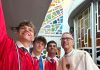
Recently, for both my own life and for Bishop Carroll Catholic High School, I have begun using the motto “Unapologetically Catholic.” This motto encapsulates everything that we as Catholics and a Catholic school should stand for, especially after reading the letter of Pope Leo. We must not shy away from who we are, but instead, embrace it, love it, and share it with others. We have to create a faithful culture that promotes prayer, vocations, faithfulness, good deeds, care, compassion, and Christian attitudes and behaviors. By creating a climate that has these components, we can become peacemakers for the world.
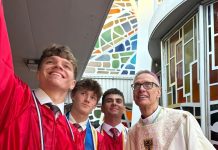
In the first few months of the school year, it has been a blessing to witness the embracing of this motto at Bishop Carroll. From top to bottom and side to side, each member of the community has openly welcomed this focus. Bishop Carroll has always been a school strong in the faith, but the time is now to double down on the faith and spread the Good News. Students have requested additional Masses, First Friday Devotions, Eucharistic Adoration, Bible Study, the Rosary, Discernment Groups, and additional Confession opportunities, which are all in addition for the extensive religious opportunities already provided. Students are turning out in large numbers and with great enthusiasm for each event. Often, because so many are participating, the time allotted just hasn’t been enough to fit everything in for each occurrence. Our understanding and supportive staff encourage and promote the faith-filled environment and recognize the importance of the spiritual development of our students. In fact, the staff joins with the students in these activities. Conversations throughout the day involve the faith, and teachers diligently work to incorporate Catholicism into every subject area. This is who we are, what we believe, and I could not be prouder of every member of the school community for embracing the belief of being “Unapologetically Catholic!”
Creating a motto such as, “Unapologetically Catholic,” is the first step in changing the culture. If we are to rise to meet Pope Leo’s challenge, we must allow the teachings of Jesus Christ to guide every action. We use the faith as a litmus test. If something does not fit within that framework, it doesn’t happen at Bishop Carroll.
Mottos can transform into mission statements. A mission statement is a formal summary of the aims and values of a company, organization, or individual. Not only should organizations create a mission statement to define their purpose, but so should every person.
The mission of Bishop Carroll Catholic High School is to “educate students in spirit, heart, mind, and body within a Catholic framework of Gospel values to become the best possible members of their families, communities, church, and world.” This statement, written decades ago, still rings true today. Thousands of individuals have graduated from Bishop Carroll with those four pillars – spirit, heart, mind, and body – as the focus of their education. Everything at the school is put through that filter test to determine if it fits the mission. The ultimate goal is to help form young adults that are ready to change the world. Lofty expectations? Absolutely. Attainable? Definitely. In order to get there, however, the school community must believe and support the mission, just as we support our own individual missions.
Our motto and mission are clear – to be the Catholic leaders the world needs. Pope Leo went on in his recent letter to say, “Those who teach in a Catholic institution are called to a responsibility that goes beyond the employment contract: their witness is worth as much as their lesson. Education is not merely the transmission of content but an apprenticeship in virtue. It forms citizens capable of serving and believers capable of bearing witness – men and women who are freer, not more isolated.” I am proud to say, and I believe Pope Leo would be proud to know, that we at Bishop Carroll are living out this mission. Being faithful Catholics does not isolate us. Instead, it makes us integral parts of our families, communities, church, and world, fulfilling our mission.
I use this opportunity as an invitation to everyone to explore a Catholic education in the Diocese of Altoona-Johnstown. No matter the area in which you live, there is a local Catholic elementary or secondary school that is primed and ready to educate the whole student – spirit, heart, mind, and body. I would be glad to speak with any family about Catholic education and even help direct them to their nearest Catholic school.
For those who do not have school-aged children, there are still opportunities for you to be supportive of the Catholic mission of our schools. First and foremost – pray. Pray for our students, teachers, staff, families, and all associated with the schools. Additionally, find other ways to support your local Catholic school financially. In a recent podcast, Father Mike Schmitz commented that only 7% of Catholic parishioners support the parish through time, talent, and treasure. He said, “Imagine if that increased just 1% to 8%. What a difference that would make!” I extend that challenge to everyone to support Catholic education. A donation, attendance at events, sponsorships, scholarships, and yes, prayer – all help support the mission.
At the close of his letter on Catholic education, Pope Leo wrote, “Every small gesture – avoiding waste, making responsible choices, defending the common good – is an act of cultural and moral literacy.” Every small act that you do for a Catholic school fits into that description. We would do well in following in the example of Saint Therese of Lisieux in her “Little Way,” that every small act is a gift to God.
In your own life, be “Unapologetically Catholic!” Show the world what a Catholic is all about – having deep faith, strong compassion, extreme generosity, and a solid heart devoted to the mission of Jesus Christ. Use the words of Saint John Henry Newman to guide you: “He has not created me for naught. I shall do good; I shall do His work. I shall be an angel of peace, a preacher of truth in my own place, while not intending it if I do but keep His commandments.”
God bless everyone, and God bless Catholic education!
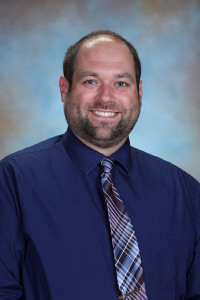
Jonathan Nagy, M.Ed., is the Principal of Bishop Carroll Catholic High School in Ebensburg and the Music Director at the Basilica of Saint Michael the Archangel in Loretto.